This time our destination was County Kildare for a visit to another Heritage Ireland site, the largest Palladian style mansion in Ireland, designed by Italian architect Alessandro Gailiei.
Casteltown House was built in 1722 by William Conolly, a self made man who became the Speaker of the House of commons and was, at the time of the home's construction, the richest man in Ireland. Unfortunately, he didn't live to see the completion of the home (he was 60 when he started construction) and his widow carried on. But it was his great nephew and wife who completed the work in the 1760's and had the greatest influence on it's final form.
The home purchased in the 1960's by the Guinness family who brought it back to splendor. It has been owned by the OPW since the 1990's.

Castletown House

Floating Staircase (photo from website)
On the way back toward Dublin, we got off the bus in suburbia so that "Mark the housing nerd" could visit the European version of Home Depot . . interesting to see all of the differences in electrical, plumbing, appliances and building materials. Have to say, I enjoyed it too.

Even the colors scream "Home Depot"
Back toward the bus-stop we dropped in at the mall to see if dinner was a possibility. . the mall was shuttering up at 7:00 p.m., and there were NO out-lot restaurants as we would see in the States, so we headed back to try another of our neighborhood offerings. REALLY wish we had found this one earlier in our visit. . . best meal since arriving in Dublin! Two chefs in a kitchen no bigger than my closet at home! The food was amazing.
When we were at Castletown on Saturday, the ticket agent told us that we MUST visit the Casino Marino just north of Dublin - - -so on Sunday, we did.
The Casino (meaning "small house") is a party house built as part of a larger estate. It is a neo-classical building mixing Greek, Roman, and Egyptian influences into a sweet mixture of fun. While it is designed to give the impression of a single room in one floor, it actually contains 16 rooms on three levels. The views across Dublin Bay were fantastic!

Only two small panels of the "door" open - part of the illusion

The big picture

Looking across Dublin Bay to the great Sugarloaf Mountain
Leaving the Casino grounds, we entertained my "urban planning nerd" by walking through the community of Marino. Built in the 1920's as part of the Garden City movement (which preceeded the Greenbelt movement in the US) - - it was interesting to see 90 years later what has worked, and what has not. I add this link for my future reference - but my planning buddies may enjoy it as well http://www.theirishstory.com/2011/09/07/a-garden-city-the-dublin-corporation-housing-scheme-at-marino-1924/.
Designed to be the first major public housing in Ireland to "empty out" the ghettos, by the time it was constructed it had priced out the ghetto dwellers and was automatically a middle class enclave. The green spaces are still there . . . .

Central green space
but the "pedestrian" streets have cars parked on the sidewalks on both sides, and many of the front gardens have been paved over for parking.
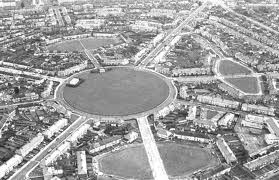
Aerial view of Marino - early days
On Monday the promised ran showed up, so we stayed a little closer to home. One more Heritage Site was in store, with a visit to the nearby St. Audoen's Church. Built in the 12th. Century in the heart of the walled city, it is the only remaining medieval parish church in Dubllin.

yes, this is a rainy day - - just wait 15 minutes!
As a pre-reformation church, it was originally Catholic, then Church of England, now Church of Ireland. Once the Church of England took it over, the congregation shrank, and parts of the roof were removed as a smaller and smaller sanctuary was needed.

Roof removed

Church still in use
Once Catholics were again allowed to worship in Ireland, there was a "new" St. Audoen's Church built TEN INCHES away from the old (Church of England) building! Built in the mid 1800's at the height of the famine, it was built to dwarf the old medieval structure, and is now home to the Polish chaplaincy in Ireland.

"new" St. Audoen's - Catholic dwarfing Church of Ireland (on left in photo)
History continues . . . .

1 comment:
Pat, How lucky you are! I went to Northern Ireland as part of an exchange program thru my church when I was 17 and stayed with two different families just outside of Belfast. I was a wonderful experience that I will always treasure and did fuel subsequent trips with the same group to other countries. Have a wonderful time and write more! Carol Davenport
Post a Comment